Mattel: The Kinetic AI Ecosystem
Beyond the Toybox: Architecting the Future of Living Play.
High Performance Management Recommendations for 2036.
BUS-510: Managerial and Org Behavior
Michael Prior, Ph.D. | Spring 2026
Austin, Chris, Lilly | CSUCI
Presentation Agenda
- Company Overview & IP Architecture
- Hardware Ecosystem Analytics
- User Friction & Interface Pain Points
- Macro Environmental Vectors (Hard/Soft)
- Critical Performance Metrics
- Blue Ocean Execution Strategy
- Individual Network Leverage Points
- Balanced Scorecard Dashboard
- Organizational Theory Applications
- Execution Recommendations
- Alternative Protocols & Risk Factors
- Questions & Answers
Company Overview
Current Business State
Mattel 1.0: Founded in 1945. 2nd largest toy manufacturer globally with $5.38B net sales and 400+ physical IP assets.
Retail Dependency: Relies heavily on physical big-box channels, with Walmart, Target, and Amazon comprising ~42% of total sales.
Strategic Shifts Required
- Unified Platform: Unified platform connecting physical hardware to digital avatars.
- Accelerate IP Pipeline: Maximize digital franchise liquidity and screen-time.
- Launch D2C Metaverse: Direct premium haptic bundled subscriptions.
- Establish Tech & Ed Partnerships: Integrate spatial computing natively and deploy AI-powered learning experiences across flagship IP.
Industry Analysis
Key Competitors
Legacy rivals (Hasbro, LEGO) are no longer the primary threat.
> EPIC GAMES
> ROBLOX
> APPLE (SPATIAL)
The Core Vulnerability
Age Compression (KGOY) is accelerating.
Analog plastic hardware cannot compete with the dopamine loops and instant gratification of digital environments. Users are migrating to virtual playgrounds at age 6 instead of 10. Mattel must meet them where they live.
User Friction Points
| Physical-Digital Play | Gen Alpha expects physical objects to scan, unlock, and level up in virtual environments natively. | |
| Sustainability Demands | Zero tolerance for plastic waste; demand for biodegradable hardware and transparent nodes. | |
| Attention Economy | Hardware must bridge into software to compete directly with hyper-optimized algorithms for daily time. | |
| Inclusive Avatars | Demand for hardware and digital skins that reflect universal diversity as a standard baseline. |
Macro Trends
Structural Trends (Irreversible)
- Mass migration to spatial computing & AR/VR hardware.
- Generative AI embedded into toys for dynamic logic.
- Strict environmental legislation dictating circular life cycles.
- Geopolitical supply chain fragmentation increasing costs.
Consumer Trends (Influenceable)
- Adult "Kidult" collectibles evolving into investment assets.
- Hardware-as-a-Service (HaaS) subscription models.
- Surge in gamified STEM and logic-based play.
- Digital-first IP creation overtaking physical-first origins.
TOWS Matrix Analysis
Internal Factors
- Iconic IP (400+ Brands)
- $1.4B Cash Reserves
- Entertainment Pipeline
- Global Mfg (6 Countries)
- NA Sales (-12-16%)
- Seasonal Dependence
- China Mfg Reliance
- Declining Doll & Preschool Sales
External Factors
- Digital/Gaming Expansion
- Adult Collectibles
- Emerging Markets
- IP-to-Entertainment Expansion
- Digital Competition
- AI Disruption
- Tariff Escalation
- Kids Aging Out Younger
| SO | Maxi-Maxi Strategy | Leverage IP for films/streaming. Expand Mattel163 globally. Enter adult collectibles & wellness play. |
| WO | Mini-Maxi Strategy | Partner with EdTech to revitalize Fisher-Price. Build digital platforms to reduce seasonality & retail reliance. |
| ST | Maxi-Mini Strategy | Acquire digital play companies. Build connected toys. Use $1.4B cash for strategic M&A defense. |
| WT | Mini-Mini Strategy | Diversify manufacturing to Mexico/SE Asia. Build automated micro-factories. Implement AI personalization. |
Mattel's perceived weaknesses (physical hardware, legacy manufacturing) are actually a competitive moat. Tactile, heritage brand experiences cannot be replicated by born-digital competitors. The physical object anchors the digital ecosystem.
Critical Success Factors
Five operational pillars required for sustained high performance in the spatial computing era:
1. IP Monetization
Maximize 400+ brands across toys, entertainment, and digital. The Barbie film ($1.4B gross) proved the model. 16 films currently in production.
2. Digital Leadership
Build the Mattel Play Universe: scalable platform connecting physical hardware to digital experiences for recurring subscription revenue.
3. Chain Resilience
Reduce China manufacturing dependence to <25% by 2028 via nearshoring (Mexico) and Southeast Asia expansion.
4. AI Educational Leadership
Build an AI-driven adaptive learning engine embedded in trusted IP. Fisher-Price, Barbie, Hot Wheels, and American Girl become personalized learning platforms, opening the $400B+ EdTech market.
5. Global Expansion
Capitalize on international growth (APAC +16% Q2 2025, LATAM growth). Reduce over-reliance on a structurally declining North American market.
Blue Ocean Framework
The Premise: Do not compete in the legacy toy market. Create uncontested spatial reality where Mattel has no direct hardware competition.
Eliminate
Low-margin, undifferentiated product lines that compete on price in commoditized categories. Redundant SKUs lacking IP value.
Reduce
Mass-market retail dependence. Seasonal revenue concentration (currently 60%+ in holidays). China manufacturing share.
Raise
Investment in digital content and AI/AR experiences. Direct-to-consumer pipelines. Expand the $250M digital transformation commitment.
Create
Play-as-a-Service: Subscription-based access to rotating hardware + digital content + exclusive IP experiences.
AI Adaptive Learning: Personalized education delivered through trusted flagship brands.
Part Disney, Part Peloton, Part Nintendo.
Platform Value Creation
| Strategy | Execution Plan | Value Created |
|---|---|---|
| IP Entertainment | Dedicated studio; streaming deals; synced toy/film launches. | High-margin revenue; multi-generational engagement. |
| Connected Play Universe | Embed NFC/Bluetooth in flagship hardware; digital collectibles. | Recurring subscriptions; 365-day engagement data. |
| Mfg. Diversification | Invest in Mexico/SE Asia; advanced AI demand forecasting. | Tariff immunity; cost stability; sustainability. |
| D2C Pipeline | Premium e-commerce; personalization engine; limited drops. | First-party data; urgency demand; brand premium. |
| Tech Partnerships | Mattel Innovation Lab; open API for toy-tech startups. | First-mover advantage in connected AI spatial play. |
| AI Learning | Fisher-Price AI Engine, Barbie Career Explorer, Hot Wheels Physics Lab. | EdTech revenue; institutional distribution; data flywheel; extended customer lifetime value. |
Layer 1: The Bridge
NFC chips + QR codes in physical hardware unlock digital assets.
Layer 2: Content Hub
Mattel163 (20M MAU) + Streaming + Spatial AR integration.
Layer 3: Marketplace
User-generated content, digital collectibles, and D2C store.
Strategic Leverage Points
Internal Leverage
- IP Portfolio (400+ Brands): Unmatched depth. Barbie/Hot Wheels = $2.9B+ sales. Impossible to replicate emotional resonance.
- Entertainment Pipeline: 16 films in production/development. A proven monetization flywheel.
- Operational Savings: $126M of $200M annualized savings achieved. Re-allocating to growth vectors.
- Digital Gaming Foothold: Mattel163 generated $200M+ in 2024 gross billings.
- Financial Strength: $1.4B cash position for M&A and platform investment.
External Leverage
- Nostalgia Economy: Adult collectibles perfectly align with heritage brand depth.
- Licensing Ecosystem: Active nodes with Disney, NBCU, Minecraft, WWE accessing existing fan bases.
- TMNT Acquisition: Securing Teenage Mutant Ninja Turtles licensing rights starting 2027.
- Emerging Market Growth: APAC (+16% Q2 2025) provides geographic diversification.
- Sustainability Differentiation: 100% recycled/bio-based plastics by 2030 creates powerful brand equity.
Balanced Scorecard Dashboard
Financial
Action: Launch D2C; $200M savings.
Req: $500M OS invest | $300M Mfg div.
Customer
Action: AI learning products; Play Universe.
Req: Content partners | UX/UI talent.
Internal
Action: AI demand forecasting; speed to market.
Req: Near-shore facilities | AI infra.
Learning
Action: Hire AI/ML & Child Dev scientists.
Req: L&D investment | Tech recruitment.
Organizational Theory
Applying systemic theoretical frameworks to Mattel's operating reality.
Chaos Theory Applied
Core Concept
Complex systems are highly sensitive to initial conditions. Small changes can cascade into large, unpredictable outcomes. Systems that appear disordered may follow underlying nonlinear patterns.
Applied to Mattel
The Barbie Cascade: A single decision to greenlight a culturally critical film became a $1.4B global phenomenon, reshaping Mattel's strategic identity.
The Decline Cascade: Small shifts toward Roblox non-linearly accelerated NA sales erosion (12-16% quarterly decline) driven by tipping points.
Managerial Implication
Mattel cannot predict all disruptions, but it can design for resilience. The organization must position itself to amplify positive cascades (entertainment wins) while buffering negative ones (supply chain shocks).
Complexity Theory
Core Concept
Organizations are complex adaptive systems—interdependent agents that self-organize and adapt. Outcomes emerge from interactions, not top-down control.
Applied to Mattel
Mattel's ecosystem (retailers, licensees, digital users, mfg partners) is adaptive. Top-down central management created fragility.
The Play Universe platform is a complexity response: create shared rules, then allow users and developers to self-organize.
Managerial Implication
Mattel must shift from controlling its ecosystem to architecting it—setting the platform conditions that allow the most favorable complex behaviors to emerge organically.
Hopf Theory of Turbulence
Core Concept
The Hopf Bifurcation describes how a system in stable equilibrium transitions into oscillating, turbulent behavior when a key parameter crosses a threshold.
Applied to Mattel
Toy sales operated in stable equilibrium for decades. The convergence of smartphone penetration, streaming, and COVID pushed the system past a Hopf bifurcation point.
Result: extreme quarterly volatility (Q2 2025 doll sales down 19%). The system is oscillating, not just declining.
Managerial Implication
Mattel cannot wait for stability to return. Strategy must be designed for turbulence—agile manufacturing and a digital platform providing stable recurring revenue regardless of retail oscillations.
Butterfly Effect
Core Concept
In sensitive complex systems, a small action in one part of the system can have enormous downstream consequences—the butterfly flapping its wings that eventually causes a hurricane.
Managerial Implication
Mattel must develop strategic scenario planning to anticipate butterfly triggers. Kotter's 8-step change model builds the infrastructure to respond rapidly when these events occur.
Applied to Mattel
- Historical: A Netflix algorithm recommending Barbie content acted as an early amplifier in cultural momentum pre-film.
- Supply Chain: A single U.S.-China tariff announcement cascades through Mattel's cost structure and pricing model.
- TMNT Licensing: The 2027 Ninja Turtles acquisition could trigger a massive franchise butterfly effect if theatrical and toy launches sync correctly.
Conclusions & Recommendations
Mattel is at a strategic inflection point. 80 years of heritage and an unmatched portfolio, facing a core business model under structural pressure.
How We Add Value
- IP-to-Entertainment: High-margin revenue with no new IP creation required.
- Play Universe: Increases customer lifetime value 3-5x via ongoing digital relationships.
- AI-Powered Learning: Transforms IP from products children outgrow into companions that grow with them.
- Mfg Diversification & DTC: Eliminates tariff vulnerability and restores retail margins.
Unique Position
Mattel occupies a position no competitor can replicate. The TAM grows from ~$100B in physical toys to a multi-hundred-billion-dollar ecosystem spanning spatial play, digital gaming, and subscriptions.
No EdTech company has Mattel's brand trust. No toy company has Mattel's AI learning engine.
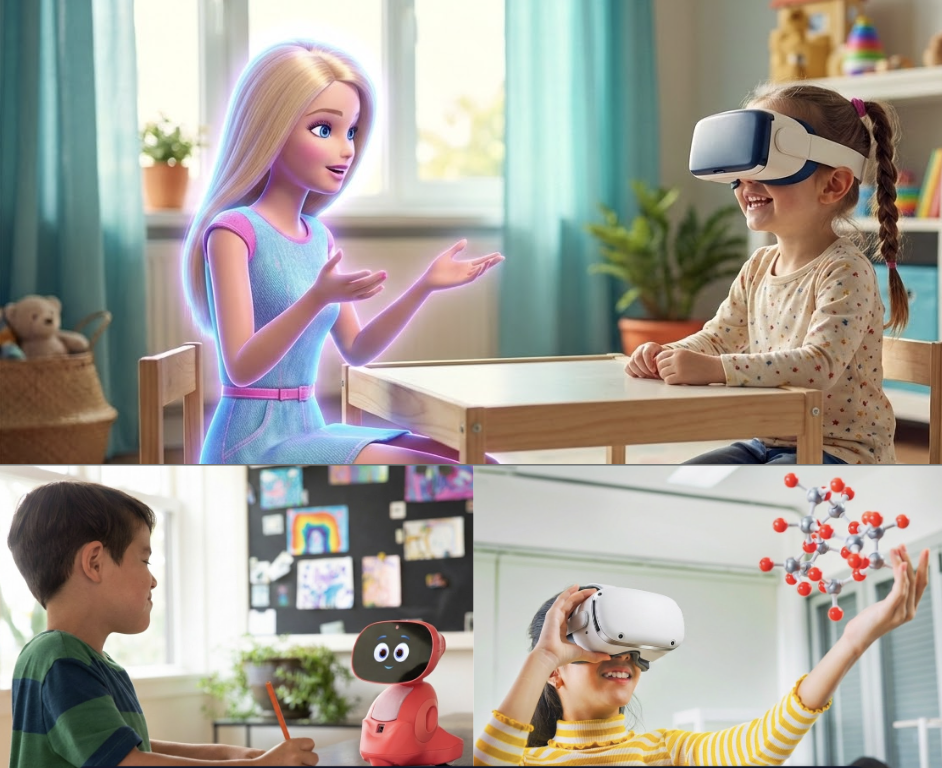
Future Scenarios
| Scenario | Strategic Response |
|---|---|
| AI Transforms Children's Education | Mattel is already there — the Fisher-Price AI Engine and flagship learning products position Mattel as the trusted bridge between AI and childhood, not a company threatened by it. |
| Metaverse as Primary Environment | Accelerate VR experiences; create interoperable digital toys across metaverse platforms. |
| Trade Fragmentation Intensifies | Complete manufacturing diversification; develop 3D printing for localized production. |
| Sustainability Regulations | Accelerate 100% bio-based materials commitment; build circular economy model (American Girl Hospital). |
| Competitive Consolidation | Use $1.4B cash position for strategic M&A; strengthen direct consumer platform relationships. |
What Surprised Us: The Physical Moat
Mattel's physical-toy heritage is a strategic moat, not a liability. In a digitally saturated world, tactile, nostalgia-driven, culturally resonant experiences are rare. The Barbie film proved that deep brand heritage generates cultural impact that born-digital competitors simply cannot match.
Alternative Strategies & Risks
Alternative Strategies Evaluated
- 1. Defensive Consolidation [Low Risk / Low Upside]: Double down on cost efficiency and core market share in existing categories. Accepts structural decline as a managed wind-down. Concedes the growth market.
- 2. Aggressive Acquisition [High Risk / High Upside]: Use $1.4B cash to acquire a major entertainment/tech company. Accelerates transformation but carries massive integration risk and execution complexity.
- 3. Licensing-First [Medium Risk / Medium Upside]: Maximize IP monetization through licensing, minimizing capital-intensive investments. Cedes control over brand experience quality and limits margin expansion.
Key Risk Factors
- Digital Execution Risk: Tech investments may not generate expected returns on timeline.
- Trade Uncertainty: U.S.-China tariff dynamics remain highly volatile.
- Entertainment Risk: Not every film is Barbie; content failure damages equity.
- Competitive Response: Big Tech (Apple, Amazon) entering connected play at scale.
- Macroeconomics: Discretionary spending contractions hit toys disproportionately.
Bottom Line: Mattel's IP portfolio and financial strength position it to lead industry transformation, despite these risks.
Q&A
Questions & Answers
"Mattel spent 80 years building the toys that children love. Our strategy ensures they spend the next building the toys that love them back."
— END OF PRESENTATION —
References & Sources
- Mattel, Inc. Annual Report 2025 (Form 10-K), February 2026
- Mattel Q2 & Q3 2025 Earnings Call Transcripts (Kreiz, 2025)
- Circana: First Half 2025 U.S. and Global Toy Industry Performance Report
- NPD Group: Global Toy Industry Outlook 2025–2034
- Kim & Mauborgne: Blue Ocean Strategy (2015)
- Kotter: Leading Change (2012)
- Senge: The Fifth Discipline (2006)
- Stacey: Strategic Management and Organisational Dynamics (2011)